All Categories
Featured
Table of Contents
Offices emptied overnight, and what was meant to be a short-lived procedure ended up being a seismic shift. Remote work blurred into hybrid models, leaving leaders scrambling to define what "back to typical" even indicated. The Fantastic Resignation followed tens of millions of workers reconsidering their concerns, leaving functions that no longer served them.
Values alignment wasn't a perk; it was table stakes. Employers responded with progressive policies, luxurious signing perks, and culture-driven retention techniques. As financial unpredictability grew, the power pendulum swung back. Go back to Workplace struck back while rolling layoffs advised workers that security was never ensured and employers aren't families, it's company.
We are now managing a multi-generational labor force with radically different definitions of success, browsing leadership challenges in real time, and rewording the social agreement of work as we go, all against the background of AI and a Wall Street/Shareholder/CEO-driven movement promoting extreme effectiveness and a "do more with less" required.
The world order itself has shifted. At the very same time, AI has actually quietly woven itself into our personal lives.
Boosting ROI Via Cloud-First AI Approaches
Chatbots like ChatGPT aid with whatever from drafting e-mails to preparing vacations, leaving us simultaneously astonished and anxious. We're adjusting to AI without a collective discussion about what it means for identity, creativity, or connection. Inflation, a cost crisis, and a basic sense that post-pandemic life feels "different" even if we can't quite put a finger on why.
The explosion of generative AI in late 2022 felt like a switch flipping overnight. Unexpectedly, anyone might produce images, code, essays, or business strategies with a few prompts.
This acceleration has fueled a wave of brand-new AI-native companies emerging unicorns like Lovable are reassessing item style with "vibe coding" and other AI-enabled techniques. The ecosystems around these tools have matured simply as rapidly. GitHub, when a specific niche platform for developers, is now the foundation of open-source partnership, powering AI developments at scale.
It moves in loops repeating, intensifying, and spawning brand-new platforms faster than companies and societies can adjust. AI Automation and augmentation are no longer theoretical. They're here, forcing organizations and people alike to ask: what is uniquely ours to do? This brief look into where we have actually been can assist us see where we are going.
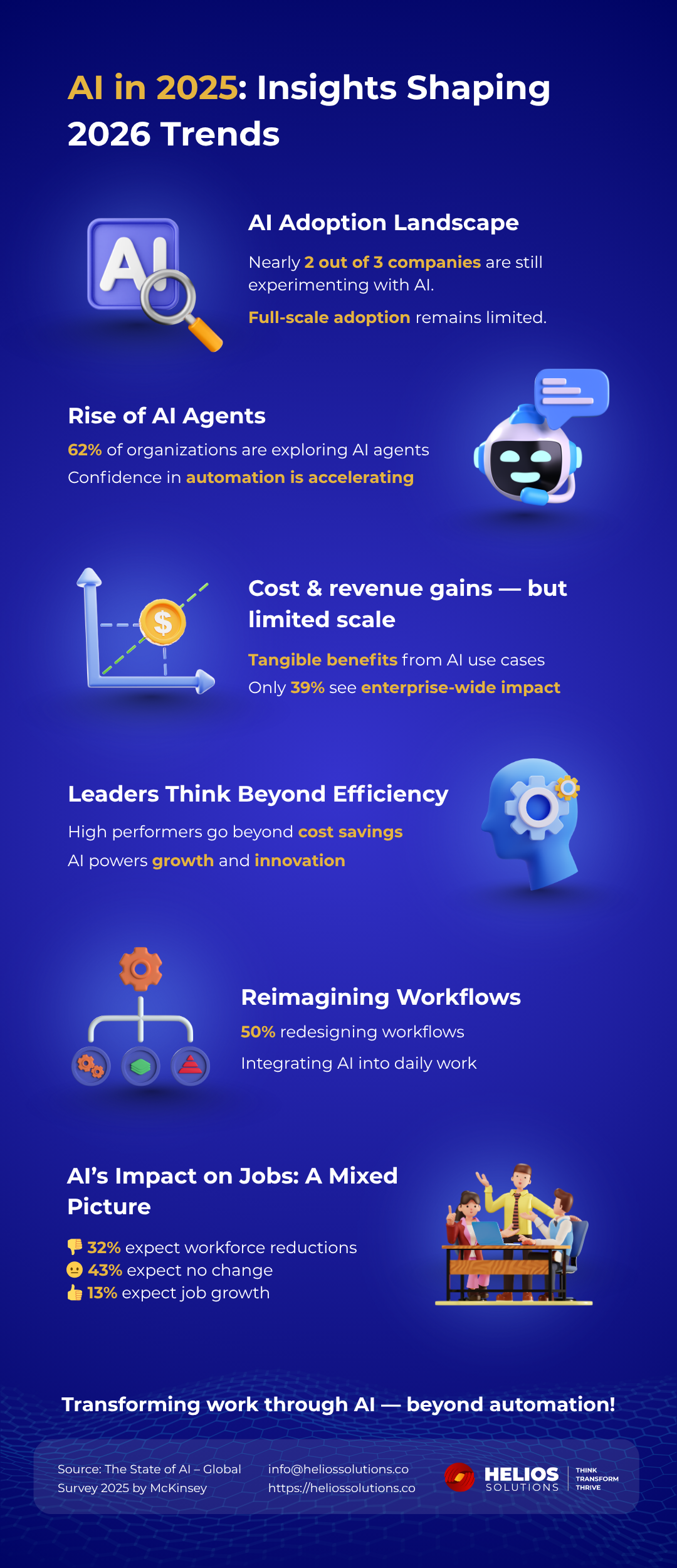
Under the surface area, new patterns have actually taken shape. If we zoom out, these patterns point toward six shifts already forming in the near distance: Press go into or click to view image in full sizeIn his prompt and cutting-edge book, Academic Ethan Mollick framed the generative AI transformation as "co-intelligence" humans and AI working together, each enhancing the other.
Strategic Planning for Your 2026 Digital Shift
The shift over the next 6 years is less philosophical and more behavioral: we start to require AI to operate at work and in daily life. Now, that reliance is currently noticeable in the numbers. Microsoft's most current Future of Work research study reveals that almost a 3rd of details workers utilize generative AI a number of times a week, and that Copilot users lean on it for high-complexity jobs at nearly three times the rate of traditional search.
Numerous workers are hiding their use of AI either due to the fact that of perception or company governance. An Anthropic research study discovered that a lot of workers use AI at work, but 69% are actively hiding their usage of it.
The work still gets done, but the scaffolding shifts from human memory and skill to a human-AI loop. This "GPS impact" waterfalls through the coming representative economy: AI not just as a tool on your desktop, but as a swarm of agents acting on your behalf, end to end. Co-intelligence becomes co-dependence when those representatives are wired into everything: your calendar, your CRM, your monetary systems, your kid's school portal.
Why AI and Cloud Integration Remains Crucial
AI deals with the rest. When those systems decrease, it will feel less like losing an app and more like losing electrical energy. AI requires human beings to exist, and we need AI to function. The risk isn't simply job replacement; it's skill atrophy, judgment erosion, and a quieter concern: what parts of being human do we wish to contract out, and what parts do we hold back, on function? These are the huge questions we will be wrestling with over the next six years.
More current quotes suggest over 70 million Americans take part in freelance work in some capability roughly one in three workers. Inside business, AI is starting to carve up what utilized to be full-time jobs into task portfolios. Microsoft's Copilot research is already mapping genuine AI usage against the U.S. Department of Labor's job taxonomy, showing that lots of professions are clusters of AI-addressable jobs rather than indivisible functions.
Synthetic intelligence can do the work currently performed by almost 12% of America's workforce, according to a current from the Massachusetts Institute of Technology. Think fractional CMOs, contract data scientists, part-time product leaders, gig-based UX teams, and AI-augmented copywriters offering their time in slices to several clients.
Moving From Old IT to Future-Proof Cloud FrameworksHistorically, pensions were replaced by 401(k)s; the next phase replaces task titles with individual operating systems and portable professional track records. It is with some paradox that lots of late-stage profession understanding employees (with gray hair) are discovering themselves transitioning into gray-collar work after a layoff.
Boomers and Gen Xers who age out, Gen Zers who pull out, and even millennials who stress out are finding themselves in the gray-collar class, either by choice or requirement. Press go into or click to see image in full sizeHigher ed is under pressure from three sides: AI in the classroom, less standard entry-level roles, and an escalating student financial obligation problem.
Key Benefits of Corporate Modernization for the Future
About 42.3 million Americans hold federal student loan debt, with overall federal balances around $1.67 trillion and approximately $1.81 trillion when you include personal loans. The Federal Reserve reports that for those who still owe money for their own education, the median debt sits in between $20,000 and $24,999. Some debtors, specifically those in specific professions or with advanced degrees, carry balances balancing over $80,000. At the very same time, policy around payment keeps shifting.
That unpredictability only amplifies suspicion from more youthful generations who already saw older brother or sisters or parents battle under loan burdens. Layer AI.

Latest Posts
Maximizing Performance Through Next-Gen Digital Architectures
Maximizing Enterprise ROI Through Modern Modernization
Empowering Organizational Change Through Strategic Adoption Roadmaps